Tech Industry 7 min read
Your next AI startup is going to look a lot like your grandpa's hardware store
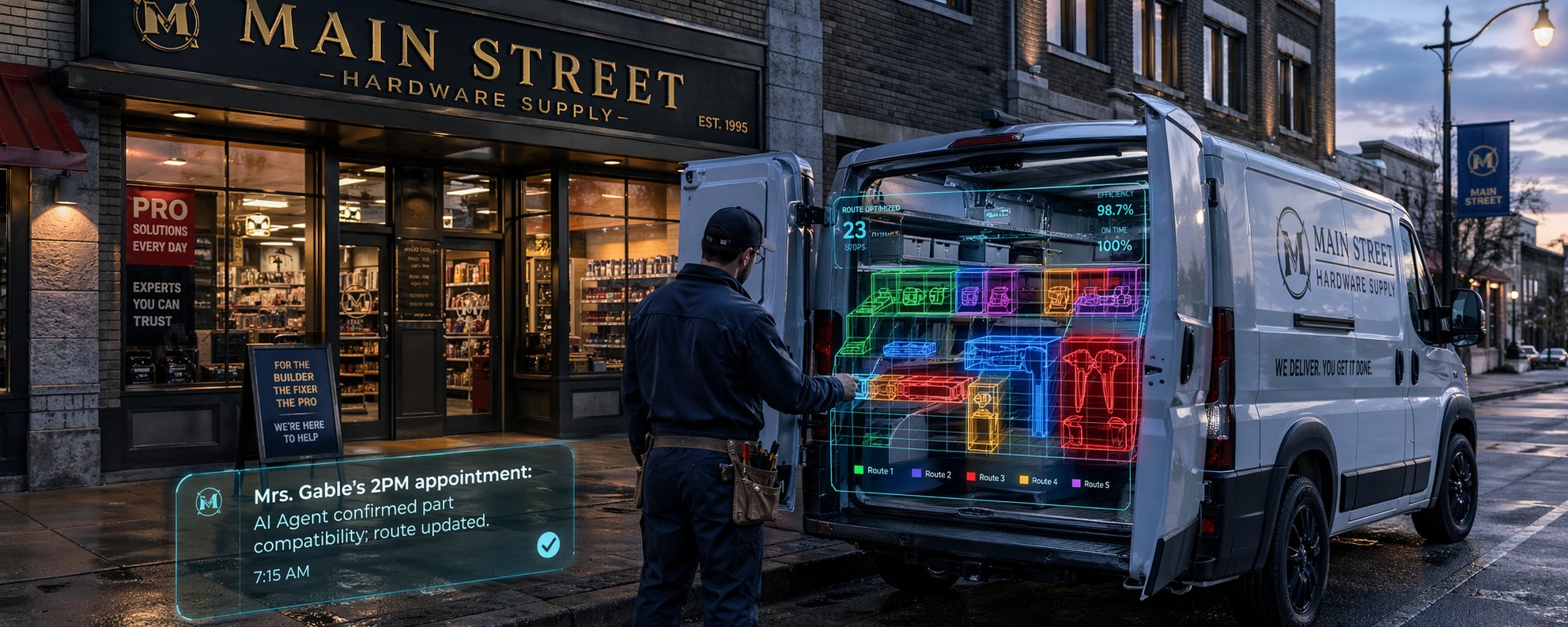 AI is making startups boring again. And that’s a good thing.
BLUF
- Foundational models will commoditize software. But they still can’t fix your weird edge cases or speak your customer’s dialect (literally and figuratively).
- The next wave of “AI startups” will look more like the small businesses of the 1960s than the unicorns of the 2010s, hyper focused on customer relationships, brand and trust.
- That’s actually a good thing: 100 x $10M companies beats 1 x $1B companies when it comes to distributing wealth.
- With unemployment projections creeping toward 20%, these AI-enabled SMBs may become the cushion that keeps the middle class from free-falling.
The great pie heist
Let’s talk about what foundational model companies are actually doing to the startup ecosystem. They’re eating everyone’s lunch + dinner, and the leftover pizza you had your eye on. Every new model release quietly obsoletes another category of software. Many of the scaffolding startups that sprinted to market in 2023-2024 are already running on borrowed time.
The bleakest version of this story goes like this: models get good enough to solve every software problem. Every new wave of capabilities swallows the startups built on the previous wave’s limitations. Eventually, no software company survives except Anthropic and OpenAI. It’s the tech equivalent of two Walmarts taking over every town on Earth.
Okay, that’s an exaggeration. But it’s a useful one.
Building a company was never just about getting the technical infrastructure right. It may have been one of the most complex / interesting parts of the story, but it was never the “only” part.
Even if the models get brilliant, someone still has to sell the thing. Someone has to walk into a room where the deal is falling apart and turn it around. Someone has to speak the language of a dairy farmer in rural Wisconsin or a logistics manager in Guadalajara (literally, not just metaphorically). Business have dealt with these “human” problems for ages:
- HR teams would spend years and $$ trying to get employees to use the enterprise software they bought.
- Healthcare systems have had electronic records for two decades and still have armies of humans reconciling data between them because no two hospitals agreed on the same workflows + the endless list of edge cases.
- Banks have fraud algorithms that flag the transaction just fine; but they still employ thousands of human investigators to make the actual call because getting it wrong is a lawsuit.
- Manufacturing industries could optimize shift schedules down to the minute with their workforce management softwares. But it can’t sit across the table from a union rep who’s been in the industry for thirty years and find the compromise that keeps the line running.
This isn’t a technology gap that the next model release will close. It’s just the real world being… the real world. And that’s exactly where the next generation of businesses gets built. Customer relationships, Brand, Trust - they are not just soft extras anymore. For a generation of tech startups that got away with ignoring them for years, they’re now the front and center of the game. Those startups could get away with it because customers simply had no alternatives. Clunky UX? Just deal with it. Tone-deaf support? Submit a ticket and wait six business days. The audacity was breathtaking, and nobody could do anything about it.
But that era is ending fast (And Thank God for that!)
Why Anthropic can’t do it all (and knows it)
Here’s the thing about foundational model companies trying to serve every market: it’s not just hard, it’s economically irrational. Solving these human edge cases is expensive and unscalable. The long tail of specific, local, industry-specific problems is precisely where general-purpose AI breaks down - and this is precisely where the next generation of startups will live.
Think about how Uber expands. They don’t build the app and launch in 500 cities on day one. They go city by city, building driver supply, understanding local regulations, adapting to local payment habits. Technology is the easy part, but the human infrastructure is the moat.
Same principle applies here. There’s a massive difference between slapping a language toggle onto a product and actually building for a local market from the ground up. This is what sets apart a business from a feature. And no foundational model company (no matter how well-resourced) can afford to be in the business of solving hyperlocal problems at global scale. That’s on AI startups to solve now.
The trillion-dollar startup is probably not coming back
Here’s a hard truth for anyone still building with the 2015 mindset: you are not going to build an app and make half the global population your TAM. The marginal cost of software, once close to zero, is no longer zero when your competitive advantage lives in relationships, local knowledge, and last-mile execution. Your growth curve is going to look linear, not exponential. And that’s okay.
In the new world, virality means something completely different. When anyone can clone your product in a week, your blast radius shrinks and your spread slows. The creative insight that once carried a startup to scale is no longer a lasting moat. But rather Execution.
The startups that win will be the ones that know their customer obsessively well. As a Product Builder, here’s my simple litmus test:
- How do you define your customer segments?
If your answer is something like “enterprise digital natives,” you’re already losing. Your competitor has already narrowed that to “digital-native DTC brands doing $5M–$50M in GMV that are scaling internationally for the first time.” That specificity is the difference between a solution that kind of works for everyone and one that feels like it was built exactly for you.
Build like it’s 1962 (but with better tools)
The irony of all this AI innovation is that it’s pushing startups back toward a fundamentally pre-internet playbook. You can’t lean on product-led growth alone anymore. You can’t substitute clever onboarding for a real sales conversation. You have to go out there - physically, digitally, likely even personally - and build exactly what your customer needs.
That’s not a step backward. That’s just good business. It’s what every durable small business has always done: earn trust incrementally, serve a specific customer deeply, and grow by being irreplaceable rather than by being viral.
The downside is real. Scaling is much harder. Your growth won’t look like a hockey stick. But the upside is something the tech industry has been quietly terrible at for thirty years: distributing the spoils.
A hundred winners, not one
Instead of one billion-dollar company minting a handful of millionaires and a few billionaires, picture a hundred $10 million companies => creating a hundred ownership stories. That’s a fundamentally different economic outcome - more business owners + more communities that benefit from a local business that actually understands them.
This matters enormously in the context of what’s coming. If AI does displace up to 20% of the workforce - and that’s not a fringe projection anymore (source) - the economy needs a new on-ramp for skilled workers. Historically, a 5–6% unemployment spike is enough to send the Fed scrambling and Congress into emergency mode. A jump to 20% is a civilizational event. Traditional policy tools won’t be enough. What might actually help is a proliferation of businesses that are small enough to hire locally, specific enough to need domain expertise, and durable enough to outlast a model release cycle.
This is the new American Dream of the tech industry, and it looks a lot like the old one.
Ownership, again
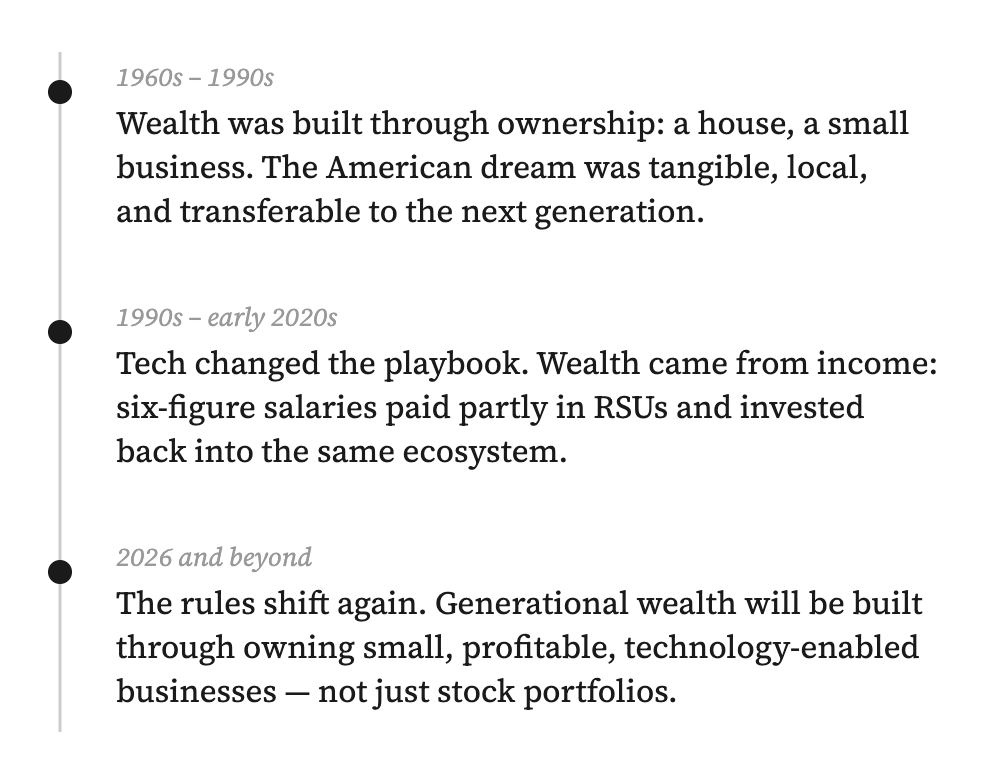
The Boomers built wealth through houses and small businesses. They transferred it to their kids through the same. The brief detour - where wealth came from tech equity, stock options, and riding a three-decade bull market in a single sector - was the historical anomaly, not the norm. For Gen Z and beyond, the path to building and transferring wealth looks less like their parents’ RSU vesting schedule and more like their grandparents’ deed of ownership. You own something, serve someone well, and build something durable enough to hand down.
The tools are better than they’ve ever been. A two-person team today can operate with the leverage of a twenty-person team from a decade ago. The opportunity isn’t gone - it’s just shaped differently. The TAM might have shrunk, but the potential for depth of integration is much higher.
Turns out your grandpa’s hardware store had some things figured out after all. He just didn’t have Claude to help him write the product spec.